
- Following announcement of groundbreaking 12-month findings for MiYOSMART iQ,1,2 HOYA Vision Care presented seven papers, four posters, a lecture, and a hands-on Eye Care Professional (ECP) education workshop across myopia management, blue light research, and personalized presbyopia correction at EAOO 2026.
- France’s Marion Wolff was named EMEA winner of the MiYOSMART Case Study Contest, with further finalists from the UK and Kazakhstan
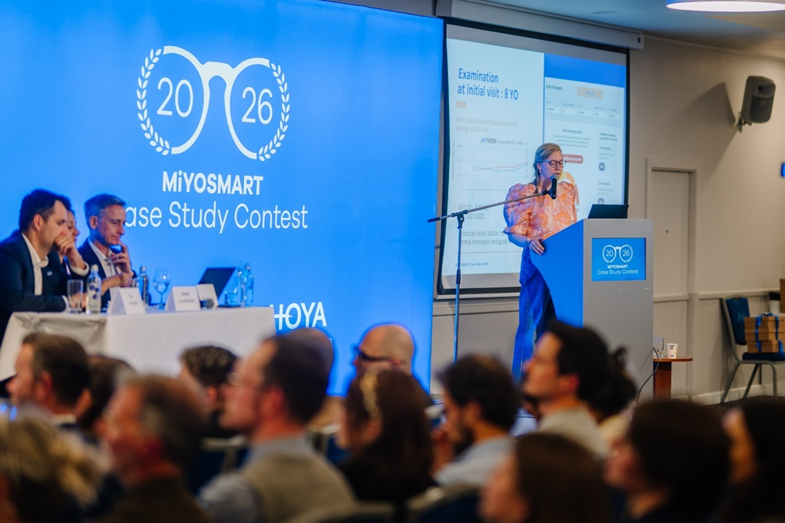
RIGA, 17 May 2026 – HOYA Vision Care reinforced its position at the forefront of innovative vision care at the 17th Annual European Academy of Optometry and Optics (EAOO) Conference, held 15–17 May 2026 in Riga, Latvia – presenting seven papers, four posters, a hands-on workshop, and a lecture, while announcing the Europe, Middle East, and Africa (EMEA) winner of its ‘Clinical excellence in myopia management’ MiYOSMART Case Study Contest.
These activities build on the recent presentation of 12-month randomized controlled clinical trial (RCT) findings for MiYOSMART iQ at ARVO 2026, demonstrating that 9 out of 10 children showed no clinically relevant myopia progression in the first 12 months of wear.*1,2
“Our commitment has always been to improve life through vision – for every patient, at every stage of life,” said John Goltermann Lassen, CEO, HOYA Vision Care. “MiYOSMART iQ has redefined what is possible in myopia control, but its real impact comes from the dedication of ECPs who deliver this innovation to the children who need it most. That is precisely why the MiYOSMART Case Study Contest matters: by elevating the real-world expertise of ECPs, we can continue to generate evidence that truly reflects the real needs of children."
The MiYOSMART Case Study Contest reflects HOYA Vision Care’s commitment to advancing myopia control through real-world clinical practice. ECPs submitted patient cases using MiYOSMART spectacle lenses in complex clinical scenarios, providing a platform to discuss practical, real‑life clinical approaches while adding to a growing body of real-world evidence.
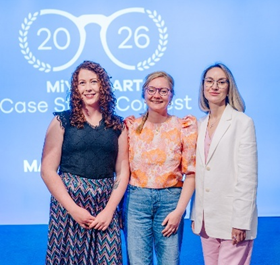
Selected from a highly competitive pool of case submissions across 30 EMEA countries, three finalists – the UK’s Dr. Stephanie Kearney, Kazakhstan’s Dr. Vitaliya Zhurba, and France’s Marion Wolff – presented their cases to a judging panel including Professor Bruce Evans (Clinical Optometrist and Visiting Professor, University of London, UK), Rupal Lovell-Patel (President, EAOO, UK), and previous finalist Max Aricochi (Optometrist, Augenzentrum Kettenbrücke, Austria).
This year’s winner, Marion Wolff of Kirchberg Ophthalmology, Greater Strasbourg, impressed the judges and the audience with a compelling 5-year clinical follow-up of a young patient treated at the critical 8–12 age window, within a strong myopic family background.
Wolff stated: “Thank you to HOYA Vision Care for your commitment to innovation in support of both patients and professionals. This case study contest truly shows the value of connecting science with real-world clinical experience, and the richness of peer-to-peer exchange – yesterday’s discussions and questions were a powerful reminder of how much we learn from each other to better serve children.”
Further demonstrating its commitment to ECP education, HOYA Vision Care delivered a hands-on workshop introducing Hoyalux iD MySense, HOYA’s most personalized progressive addition lenses (PAL) yet. Delegates gained experience with visuSense, the company’s advanced measurement system that assesses each patient's Visual Sensory Intelligence† to deliver a high level of personalized PAL performance. Adding further clinical depth, Professor Fabrizio Zeri presented findings on PAL adaptation outcomes in previously successful and unsuccessful wearers.3
In addition to HOYA Vision Care’s bank of myopia management evidence presented, Professor Evans delivered a 30-minute lecture entitled ‘Building the evidence-base: 10 tips for optometric researchers’, his educational leadership complementing his role on the contest judging panel. Professor Giancarlo Montani presented research evaluating the effect of blue light attenuator lenses on visual comfort, visual functions, and digital eye strain symptoms.4
* Clinically relevant myopia progression is defined as Spherical Equivalent Refraction change strictly superior to -0.50D over 12 months of wear. Results are based on outcomes in myopic children aged 4 to 12 years and may vary depending on age and baseline characteristics at the start of MiYOSMART iQ treatment.
† Visual Sensory Intelligence is defined by HOYA as the individual ways people perceive and respond to visual stimuli based on their personal experiences and sensory needs. The Visual Sensory Intelligence includes patients' clarity requirements, gaze refocusing pattern and posture.
Disclaimer: This material is intended for informational purposes for professional audiences and reflects scientific findings presented at a professional conference. It is not intended as a promotion or solicitation for any product in jurisdictions where such product is not approved, including the United States. Product availability and approvals vary by country.
All HOYA Vision Care supported presentations at EAOO 2026:
- Giancarlo Montani, Salento, Italy: Effect of Blue Light Attenuator Lenses on Visual Comfort, Visual Functions and Digital Eye Strain Symptoms
- Bruce Evans, London, UK: Building the evidence-base: 10 tips for optometric researchers
- Kathryn Sauders, Belfast, Ireland: Multi-Site Intervention Trial of Defocus Incorporated Multiple Segments (DIMS) spectacle lenses in UK children: 3-year results
- Blanca Alonso Abad, Madrid, Spain: Combination treatment with atropine and defocus incorporated multiple segment spectacle lens: Impact on vision-related quality of life in myopic children
- Bruno Songel-Sanchis, Madrid, Spain: Choroidal Remodeling in Myopia Management: Findings from the One-Year ASPECT Study
- Alicia Ruiz Pomeda, Madrid, Spain: Atropine and Spectacle lens Combination Treatment (ASPECT): 24-month results of a randomised controlled trial for myopia control
- Natalia Vlasak, Amsterdam, Netherlands: New Defocus Incorporated Multiple Segments Spectacle Lens with Triple Enhanced Design Effectively Controls Myopia Progression
- Matilde Ronzoni. Milan, Italy: Results of the first Italian Delphi study on paediatric myopia management: multidisciplinary comparison and definition of a shared clinical-operational protocol
- Giancarlo Montani, Salento, Italy: Evaluation of Adaptation and Visual Performance with Different Ophthalmic Lens Technologies for Myopia Management
- Bruce Evans, London, UK: Binocular vison anomalies in Scotland at age 3.5-5.5 years: an epidemiological study
- Giulia Carlotta Rizzo, Milan, Italy: Reading performance of elderly and young people at the Rate of Reading test (RRT)
- Fabrizio Zeri, Milan, Italy: Adaptation outcomes with progressive addition spectacle lenses in previously successful and unsuccessful wearers

